Skip to content
USA

New York visual practice

New York practice test 3: Questions and answers

Review all 15 selected questions before you try the interactive test again.

Question 1 of 15

Visual for New York practice question 1

If at a railroad crossing you see flashing red lights, lowered crossing gates, or hear ringing bells it means

  1. you must increase your speed
  2. you must stop at least 15 feet from the railroad tracks.
  3. you must stop at least 50 feet from the railroad tracks.
  4. you must reduce speed and continue driving with caution.

Correct answer

you must stop at least 15 feet from the railroad tracks.

Explanation

When approaching a railroad crossing with flashing red lights, lowered gates, or ringing bells, the correct action is to stop at a safe distance. This ensures the safety of both the driver and passengers, as it allows sufficient time to observe and react to any approaching train.

💡 Remember: Always stop a car's length away—roughly 15 feet—from tracks when signals activate.

Question 2 of 15

Visual for New York practice question 2

When you approach a traffic circle, roundabout or rotary, you are required to give the right-of-way to

  1. pedestrians
  2. vehicles already within the roundabout
  3. neither vehicles already within the roundabout nor pedestrians
  4. both vehicles already within the roundabout and pedestrians

Correct answer

both vehicles already within the roundabout and pedestrians

Explanation

💡 How to Navigate a Roundabout: Motor Vehicles • When approaching the roundabout, follow the lane designation signs and choose the proper lane for multi-lane approach roadways, slow down, and yield to pedestrians in the crosswalk. • Look to the left. Traffic in the roundabout has the right-of-way. • Approach the yield line and enter the roundabout when there is an adequate gap in the circulating traffic flow. • If another car is waiting at the yield line ahead of you, do not stop in the crosswalk. Keep the crosswalk clear for pedestrians. • Bicyclists are permitted to ride within the roundabout and will be riding in the lane just as other vehicles do. Please do not pass a bicycle in the roundabout.

Exiting the Roundabout • Once you have entered the roundabout, proceed counterclockwise to your exit. You now have the right-of-way. • As you approach your exit, turn on your right turn signal. • Exit the roundabout, yielding to pedestrians in the crosswalk.

Question 3 of 15

Visual for New York practice question 3

What should you do if another car is passing you on the left?

  1. slow down a little and stay centered in your lane.
  2. reduce your speed and keep to the left
  3. just boost your speed
  4. pull over and stop

Correct answer

slow down a little and stay centered in your lane.

Explanation

When another car is passing you on the left, it is essential to maintain a safe and smooth traffic flow. Slow down slightly and stay centered in your lane to avoid interfering with the passing vehicle’s maneuver. This helps the driver complete the pass safely and reduces the risk of collisions.

Question 4 of 15

Visual for New York practice question 4

What must you do if you see this flag person's signal?

  1. it doesn't mean anything
  2. boost your speed
  3. slow down.
  4. stop.

Correct answer

slow down.

Explanation

A flag person on the road signifies construction or maintenance activities ahead, requiring drivers to adjust their speed for safety. This signal serves to ensure the safety of both workers and drivers by cautioning them to be prepared for changes in the flow of traffic or road conditions.

💡 Remember: A flag indicates caution, just like yellow traffic lights, prompting you to reduce speed and proceed carefully.

Question 5 of 15

Visual for New York practice question 5

What does the sign mean?

  1. a yield sign.
  2. a merge sign.
  3. a One Way sign.
  4. a stop sign.

Correct answer

a stop sign.

Explanation

The image depicts a red, octagonal sign positioned at an intersection. This shape and color combination universally indicates the need to come to a complete halt before proceeding.

💡 Remember: The octagonal shape and red color signify "STOP." Whenever you see this shape, associate it with stopping.

Question 6 of 15

Visual for New York practice question 6

What is against the law in New York State while driving?

  1. have a talk using a portable smartphone.
  2. Listen using a portable smartphone.
  3. send SMS messages using a portable smartphone.
  4. Perform any action mentioned above.

Correct answer

Perform any action mentioned above.

Explanation

💡Driver Distractions A distraction is anything that takes your attention away from driving. Distracted driving can cause crashes, resulting in injury, death, or property damage. Taking your eyes off the road or hands off the steering wheel presents obvious driving risks. Mental activities that take your mind away from driving are just as dangerous.

When driving: • Do not use cell phones or text. • Avoid arguments and stressful or emotional conversations with passengers. • Avoid eating while driving. • Be sure children are properly and safely restrained. •Properly secure pets in a pet carrier or portable kennel. You must pay attention to the driving task. You are responsible for operating your vehicle in a safe manner.

Question 7 of 15

Visual for New York practice question 7

What does this sign mean?

  1. A divided highway ends ahead
  2. There is a divided highway begins ahead.
  3. Turning left is not allowed ahead
  4. Traffic will be flowing in only one direction starting ahead.

Correct answer

There is a divided highway begins ahead.

Explanation

The image depicts a road sign indicating that a divided highway begins ahead. The sign shows two arrows pointing in opposite directions, separated by a barrier, which signifies that the roadway will split into two separated lanes.

💡 To remember this, think of the arrows separated by a barrier implying the start of a divided highway, with traffic flowing in two directions.

Question 8 of 15

Visual for New York practice question 8

What does the sign mean?

  1. a medical facility.
  2. A recreational area for children.
  3. a school zone.
  4. stopping place for buses

Correct answer

a school zone.

Explanation

💡 This is a yellow pentagon-shaped warning sign showing an adult and a child, indicating a school zone ahead. Slow down, be prepared for pedestrians crossing, and drive with extra caution. Watch for children at all times, not only during school hours.

Question 9 of 15

Visual for New York practice question 9

The majority of deer-vehicle collisions, about 66%, happen during the months of

  1. June, July, and August.
  2. January, February, and March.
  3. March, April, and May.
  4. October, November, and December.

Correct answer

October, November, and December.

Explanation

💡 How to Avoid Collisions with Deer Two-thirds of all deer-vehicle collisions occur during the months of October, November and December. This is also the time when deer breed and when they travel the most. Daily deer activity is highest at dawn and dusk, which often is the highest time of travel for motor-vehicle commuters. Deer travel in groups - if you see one, expect more. Areas where there have been many deer-vehicle collisions often are marked with deer crossing signs. 💡 The New York State Department of Environmental Conservation recommends these precautions motorists can take to reduce the chance of a deer hit: • Be careful when you drive at dawn and dusk; this is when driver visibility is bad and the deer are most active. • The risk of deer-vehicle collisions increases when deer movements increase during breeding season in October, November and December. • Decrease speed when you approach deer near roadsides. Deer can "bolt" or change direction at the last minute. • If you see a deer go across the road, decrease speed and be careful. Deer travel in groups, expect other deer to follow. • Use emergency lights or flash your headlights to warn other drivers when deer are seen on or near the road. • Use caution on roadways marked with deer crossing signs. These signs are put in areas that have had a large number of deer-vehicle collisions.

Question 10 of 15

Visual for New York practice question 10

What does this sign mean?

  1. Drivers are prohibited to give up their right of way and let other drivers go before them.
  2. Passing on the right is strictly prohibited for drivers.
  3. Drivers are prohibited to turn left.
  4. Drivers are prohibited to turn right.

Correct answer

Drivers are prohibited to turn right.

Explanation

The sign depicted indicates a prohibition on making right turns. This is shown by a right-turn symbol with a red circle and a slash through it, signaling that such action is not allowed.

Question 11 of 15

Visual for New York practice question 11

On a two-way road outside of New York City, what action are you allowed to take on a red light after stopping and yielding to pedestrians and approaching traffic?

  1. turn left
  2. turn neither left nor right
  3. turn left or right
  4. turn right

Correct answer

turn right

Explanation

On a two-way road, you must stop on red; going straight and turning left on red are prohibited, while turning right may be allowed after stopping and yielding (outside NYC and if no signs prohibit it).

🚦 Turning on a red light:

👉 General rules (for New York State): • You may turn right on a red light after coming to a full stop and yielding to traffic and pedestrians • You may turn left on a red light only when turning from a one-way road onto another one-way road, after a full stop and yielding • You cannot turn on red if there is a “NO TURN ON RED” sign or any other restriction (signal or marking)

👉 Special rule (for New York City): • Turning on a red light is prohibited by default • It is allowed only if a special sign permits it

Question 12 of 15

Visual for New York practice question 12

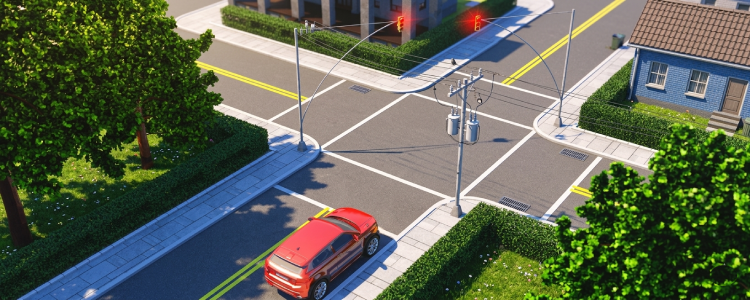
What should you do when approaching a flashing yellow light at an intersection

  1. increase your speed to surpass the light before it changes to red.
  2. reduce speed and proceed with caution.
  3. stop and wait for the light to turn green.
  4. get ready to stop; the light is about to turn red.

Correct answer

reduce speed and proceed with caution.

Explanation

🟡 Yellow traffic light • Steady Yellow: The light will change from green to red. Be prepared to stop for the red light. • Flashing Yellow: Drive with caution. • Yellow Arrow: The protection of a green arrow will end. If you intend to turn in the direction of the arrow, be prepared to stop.

Question 13 of 15

Visual for New York practice question 13

Typically, work zones have

  1. raised speed limits.
  2. no speed limits.
  3. reduced speed limits.
  4. a speed limit of 10 mph.

Correct answer

reduced speed limits.

Explanation

In work zones, speed limits are typically reduced to enhance safety for both workers and drivers. Lower speeds help prevent accidents and allow drivers more time to react to unexpected conditions.

Question 14 of 15

Visual for New York practice question 14

Which lane on multilane roads is intended for passing slower vehicles?

  1. rightmost
  2. center
  3. leftmost
  4. shoulder

Correct answer

leftmost

Explanation

On multilane roads, the designated lane for passing slower vehicles is used to improve traffic flow and safety by allowing faster-moving vehicles to overtake those traveling at a reduced speed. This practice is a standard traffic regulation in many regions.

Question 15 of 15

Visual for New York practice question 15

What is the specified distance within which parking is prohibited from a fire hydrant?

  1. 20 feet
  2. 15 feet
  3. 8 feet
  4. 6 feet

Correct answer

15 feet

Explanation

💡 You cannot park, stop or stand: • Within 15 feet (5 m) of a fire hydrant, unless a licensed driver remains in the vehicle to move it in an emergency. • On the roadside of a parked vehicle ("double parking"). • On a sidewalk or in a crosswalk. • In an intersection, unless permitted by signs or parking meters. • On railroad tracks. • Next to or opposite road work, construction or other obstructions if your vehicle blocks traffic. • Within 30 feet (10 m) of a pedestrian safety area, unless another distance is marked. • On a bridge or in a tunnel.