Skip to content
USA

New York visual practice

New York practice test 1: Questions and answers

Review all 15 selected questions before you try the interactive test again.

Question 1 of 15

Visual for New York practice question 1

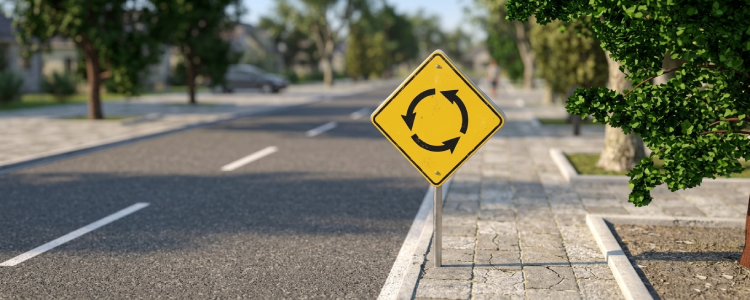
What does this sign mean?

  1. A roundabout
  2. A crossroad
  3. A divider
  4. An interstate highway

Correct answer

A roundabout

Explanation

The image displays a circular arrow symbol on a yellow diamond-shaped sign, indicating an upcoming circular intersection. This sign warns drivers to prepare for traffic flowing in a circular path around a central island.

💡 To remember this, associate the circular arrows with the motion of a roundabout, guiding vehicles in a loop.
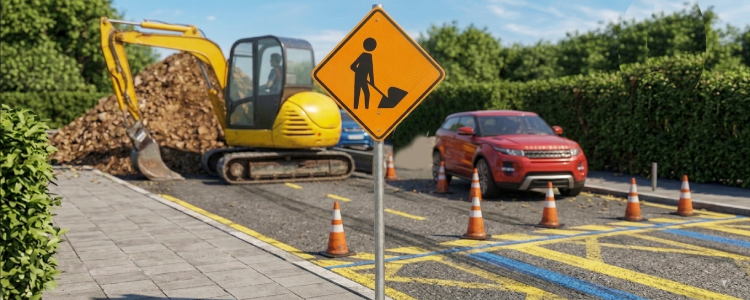
Question 2 of 15

Visual for New York practice question 2

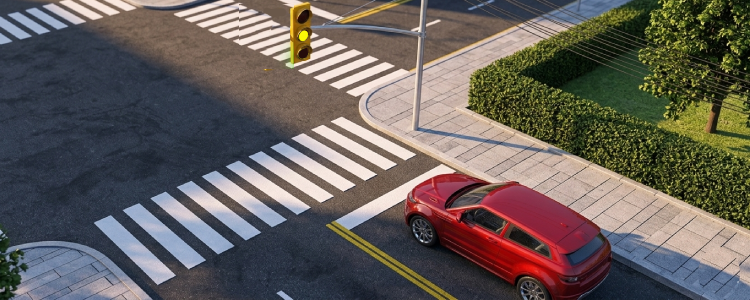
When you reach an intersection, a steady yellow traffic light signals that you are required to

  1. Get ready to stop at a red light.
  2. Increase your speed in order to pass through the signal before it changes to red.
  3. Keep up the speed
  4. Decrease your speed and move forward attentively.

Correct answer

Get ready to stop at a red light.

Explanation

🟡 Yellow traffic light • Steady Yellow: The light will change from green to red. Be prepared to stop for the red light. • Flashing Yellow: Drive with caution. • Yellow Arrow: The protection of a green arrow will end. If you intend to turn in the direction of the arrow, be prepared to stop.

Question 3 of 15

Visual for New York practice question 3

Which of the given sentences about work zones is NOT true?

  1. Warning signs indicating work zones are frequently placed ahead of the work area.
  2. You are obliged to follow the instructions given by a flag person.
  3. The penalty for exceeding speed limits in a construction area is only doubled if workers are present.
  4. Some work zones can be mobile.

Correct answer

The penalty for exceeding speed limits in a construction area is only doubled if workers are present.

Explanation

The statement in question is not true because penalties for speeding in construction zones are typically enforced whether or not workers are present to ensure safety and compliance at all times in the area. This measure promotes caution and respect for speed limits to protect both workers and drivers.

💡 Remember: Safety in work zones is paramount, and speed limits must be respected at all times, regardless of worker presence.

Question 4 of 15

Visual for New York practice question 4

What should you do if you see this road sign?

  1. Boost your speed
  2. Slow down and give way.
  3. Bring your vehicle to a full halt.
  4. Turn to the right.

Correct answer

Slow down and give way.

Explanation

This road sign indicates that you must yield, meaning you should reduce your speed and allow other vehicles or pedestrians to proceed before you continue.

💡 Remember: The triangle shape points downwards, symbolizing a downward shift in speed and priority.

Question 5 of 15

Visual for New York practice question 5

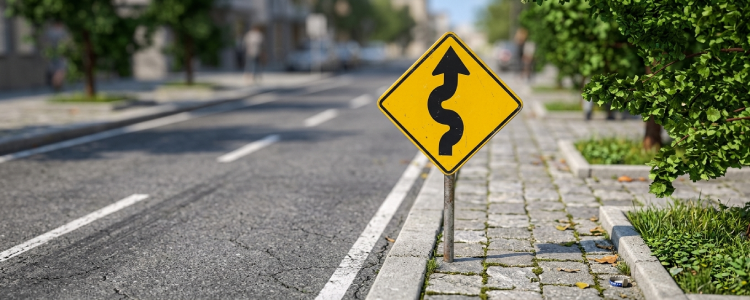
This sign indicates a caution against

  1. a narrow road ahead.
  2. a sharp curve ahead.
  3. A winding road ahead.
  4. A bumpy road ahead.

Correct answer

A winding road ahead.

Explanation

The sign depicted in the image warns drivers of a road that twists and turns ahead, suggesting the need for cautious driving.

💡 Remember the right answer by associating the wavy line on the sign with the twists and turns of a winding road.

Question 6 of 15

Visual for New York practice question 6

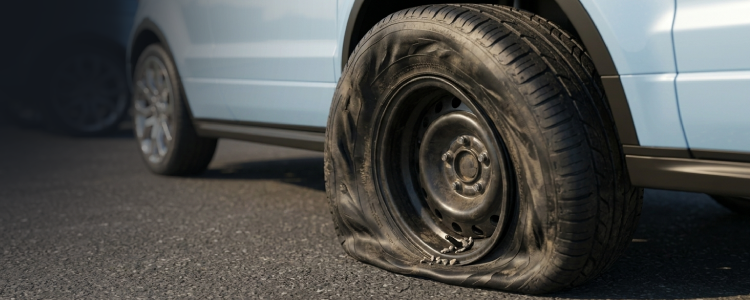
What actions should you take if a tire suddenly deflates/blows while driving?

  1. Press down on the accelerator pedal.
  2. Strongly press down on the brakes.
  3. Keep hold of the steering wheel tightly.
  4. Change to a higher gear.

Correct answer

Keep hold of the steering wheel tightly.

Explanation

TIRE BLOWOUT - A thumping sound can be a warning that a blowout is about to occur. If you hear it, get safely off the road and check your tires. If a tire blows out, hold the steering wheel tightly and slowly take your foot off the gas pedal. If your vehicle skids, handle it as you would on ice or snow. Do not use your brake until your vehicle is controlled. Leave the road when it is safe to do so.

Question 7 of 15

Visual for New York practice question 7

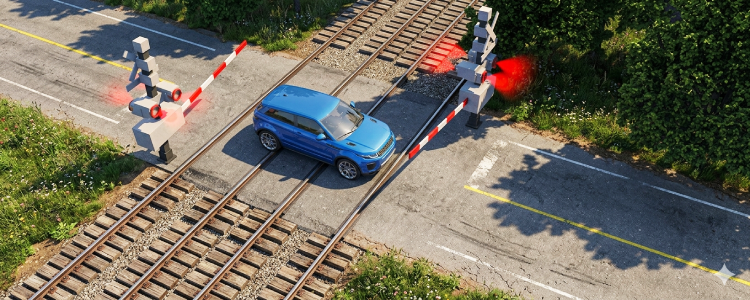
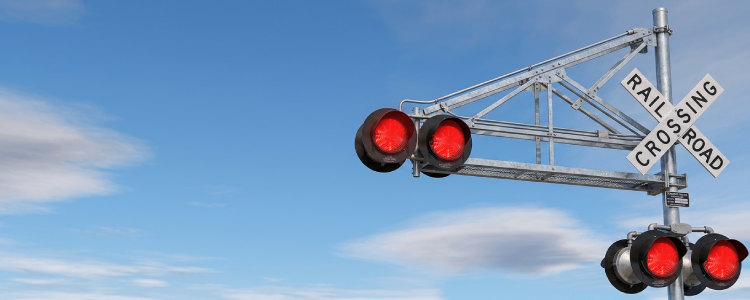
What actions should you take if your vehicle is stuck on railroad tracks while a train is coming up?

  1. Ensure your doors are open and make an effort to alert the train.
  2. Attempt to reboot the engine.
  3. Attempt to move your vehicle away from the railway tracks.
  4. Evacuate all passengers from the vehicle and keep them at a safe distance.

Correct answer

Evacuate all passengers from the vehicle and keep them at a safe distance.

Explanation

STALLING ON RAILROAD TRACKS - If a train approaches, release your seat belt, leave the vehicle and get as far away as you can from the tracks. Run toward the general direction the train is coming from. If you run "down the track" in the same direction as the train, you can be hit with debris when the train hits your vehicle. When you are completely sure no trains are coming, open your window to listen for a train and try to start the engine. If that fails, shift your vehicle into neutral and push it from the tracks.

Question 8 of 15

Visual for New York practice question 8

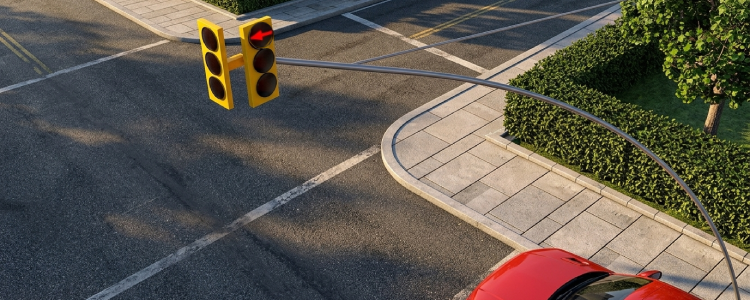
Are you allowed to turn on a red arrow?

  1. Yes.
  2. Yes, but only when the arrow is facing towards the left direction.
  3. Sure, but it's only valid when the arrow indicates the right direction.
  4. No, not in the direction indicated by the arrow.

Correct answer

No, not in the direction indicated by the arrow.

Explanation

🔴 Red traffic light • Steady Red: Stop. Do not go until the light is green. If a green arrow is shown with the red light, you can go toward the arrow and only if the intersection is clear. - You can make a right turn at a steady red light after you come to a full stop and yield the right-of-way to oncoming traffic and pedestrians. You can make a left turn at a steady red light when you turn from a one-way road into another one-way road after you come to a full stop and yield the right-of-way to oncoming traffic and pedestrians. - You cannot make a turn at a red light if there is a NO TURN ON RED sign posted or another sign, signal or pavement marking prevents the turn. You are not allowed to turn on a red light in New York City unless a sign that permits it is posted.

• Flashing Red: Means the same as a STOP sign: Stop, yield the right-of-way, and go when it is safe.

• Red Arrow: Do not go in the direction of the arrow until the red arrow light is off and a green light or arrow light goes on. A right or left turn on red is not permitted at a red arrow.

Question 9 of 15

Visual for New York practice question 9

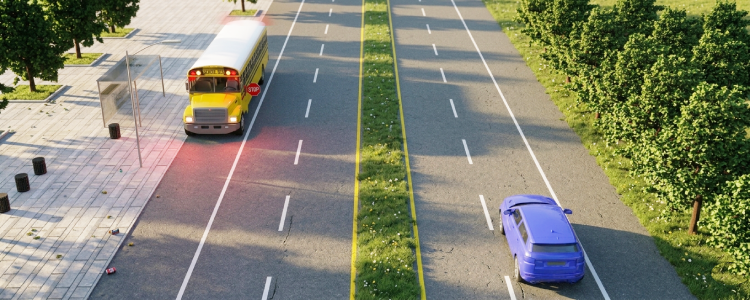
What should you do if you come across a school bus that has stopped on the opposite side of a divided highway with flashing red lights?

  1. Proceed with caution.
  2. Reduce your speed and continue with caution.
  3. Stop and remain stopped until the red lights stop flashing.
  4. increase your speed

Correct answer

Stop and remain stopped until the red lights stop flashing.

Explanation

When a stopped school bus flashes its red light(s), traffic that approaches from either direction, even in front of the school and in school parking lots, must stop before it reaches the bus. You should stop at least 20 feet (6 m) away from the bus. You can identify this bus by a "SCHOOL BUS" sign, the red lights on the top, and its unique yellow orange color.

When you stop for a school bus, you cannot drive again until the bus starts moving again or when the bus driver or a traffic officer signals that you can proceed. This law applies on all roadways in New York State. You must stop for a school bus even if it is on the opposite side of a divided highway.

Question 10 of 15

Visual for New York practice question 10

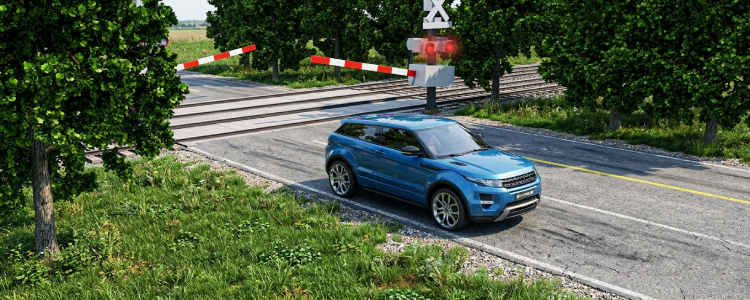
Is it ever allowed to pass a lowered railroad gate at a railroad crossing?

  1. If a train isn't visible nearby
  2. If you're confident you can cross before the train comes.
  3. If you observe that a train has passed
  4. Never

Correct answer

Never

Explanation

Passing a lowered railroad gate at a crossing is never allowed as it poses severe safety risks. The lowered gate indicates an approaching train, and attempting to cross can lead to catastrophic consequences. It is crucial to wait until the gates are fully raised, and lights stop flashing before proceeding.

💡 Remember: A lowered gate means STOP. Think of the gate as an absolute barrier, not a suggestion.

Question 11 of 15

Visual for New York practice question 11

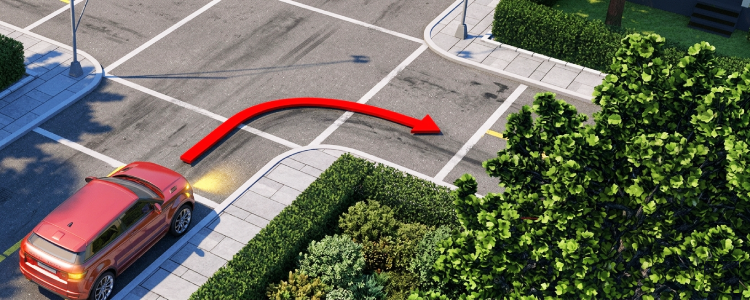
When turning right, you should turn into

  1. the left lane.
  2. the right lane.
  3. the lane with the least traffic.
  4. any lane you want

Correct answer

the right lane.

Explanation

When turning right, you should turn into the right lane because it keeps traffic organized and predictable, reducing the likelihood of accidents.

💡 Remember: "Right turn, right lane." This simple rule helps maintain traffic flow and safety.

Question 12 of 15

Visual for New York practice question 12

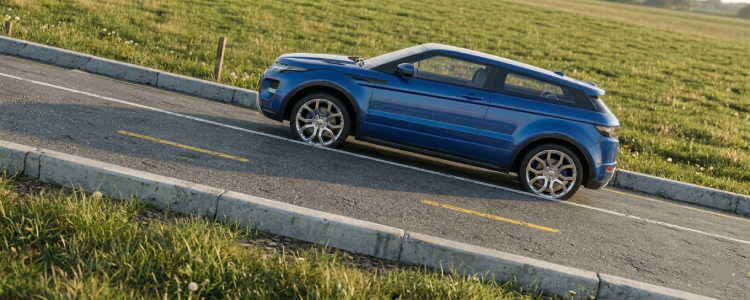
When parking next to a curb, facing uphill, in which direction should you turn your front wheels?

  1. Away from the curb
  2. Toward the curb
  3. Straight
  4. it does not matter

Correct answer

Away from the curb

Explanation

💡 Parking rules depend on whether you are on a hill: • No hill (level street) - Turn your wheels parallel to the curb

• ⛰️ With a hill 1) ⬆️ Uphill with curb - Turn wheels away from the curb

2) ⬇️ Downhill with curb - Turn wheels toward the curb

3) 🚫 Uphill or downhill with NO curb - Turn wheels toward the edge of the road

Question 13 of 15

Visual for New York practice question 13

How many feet is it prohibited to park within a railroad crossing?

  1. 50
  2. 25
  3. 30
  4. 15

Correct answer

50

Explanation

💡 Parking or standing is not allowed: • In front of a driveway. • Within 20 feet (6 m) of a crosswalk at an intersection. • Within 30 feet (10 m) of a traffic light, STOP sign or YIELD sign. • Within 20 feet (6 m) of a fire station driveway, or within 75 feet (23 m) on the opposite side of the road. • Along a curb that is cut, lowered or made for access to the sidewalk. • You cannot park your vehicle within 50 feet (15 m) of a railroad crossing.

Question 14 of 15

Visual for New York practice question 14

Before changing lanes, it is necessary to

  1. check your blind spots.
  2. check your mirrors.
  3. signal your intentions
  4. do all of the above.

Correct answer

do all of the above.

Explanation

To safely change lanes, you must perform all necessary precautions. Checking your blind spots ensures no vehicle is unseen. Checking your mirrors provides a clear view of the adjacent lanes. Signaling your intentions communicates your plans to other drivers, enhancing road safety.

💡 Remember: "Mirror, Signal, Blind Spot" - cover all angles before a lane change.

Question 15 of 15

Visual for New York practice question 15

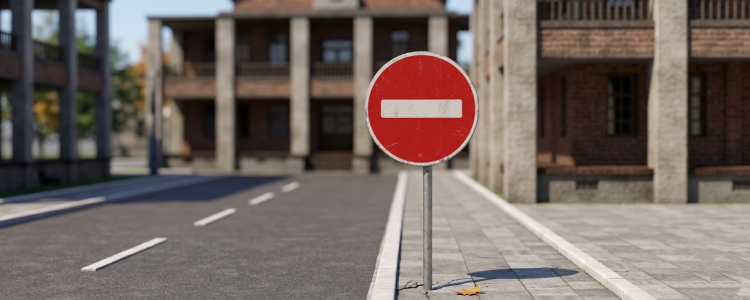
What does this sign indicate if you wish to turn onto a roadway?

  1. You must yield to pedestrians and make your turn.
  2. You are only allowed to access this roadway by making a right turn.
  3. This roadway is exclusive for trucks and buses.
  4. You are not allowed to enter this roadway.

Correct answer

You are not allowed to enter this roadway.

Explanation

A "Do Not Enter" sign is usually installed at the beginning of one-way streets and ramps and it prohibits drivers from entering a one-way roadway where traffic is moving in the opposite direction. A DO NOT ENTER traffic sign is usually installed together with the "WRONG WAY" sign.