Skip to content
USA

New York visual practice

New York practice test 2: Questions and answers

Review all 15 selected questions before you try the interactive test again.

Question 1 of 15

Visual for New York practice question 1

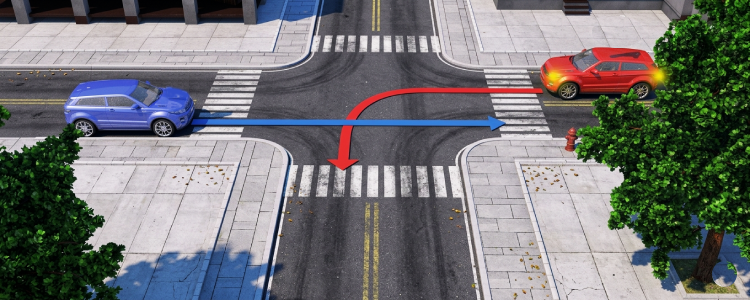
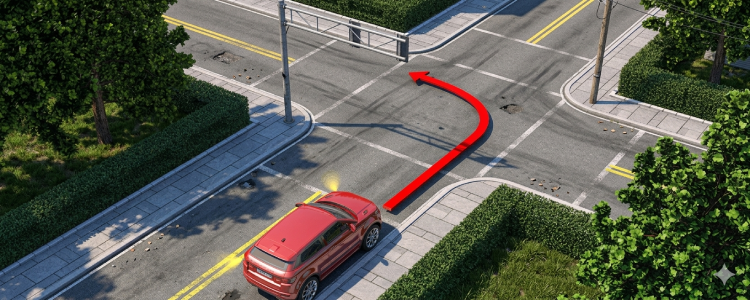
Two cars are arriving from opposite sides approach an intersection at the same time. Who should yield the road?

  1. The car making a right turn must give way to the car making a left turn.
  2. The car on the left has the right of way over the car on the right.
  3. The car with more passengers should be given priority.
  4. The car making a left turn must yield to the car proceeding straight or making a right turn.

Correct answer

The car making a left turn must yield to the car proceeding straight or making a right turn.

Explanation

💡 If drivers approaching from opposite directions reach an intersection at about the same time, a driver that turns left must yield to traffic that moves straight or turns right.

Right-of-Way: Traffic signs, signals and pavement markings do not always resolve traffic conflicts. A green light, for example, does not resolve the conflict of when a car turns left at an intersection while an approaching car goes straight through the intersection. The right-of-way rules help resolve these conflicts. They tell you who goes first and who must wait in different conditions.
Question 2 of 15

Visual for New York practice question 2

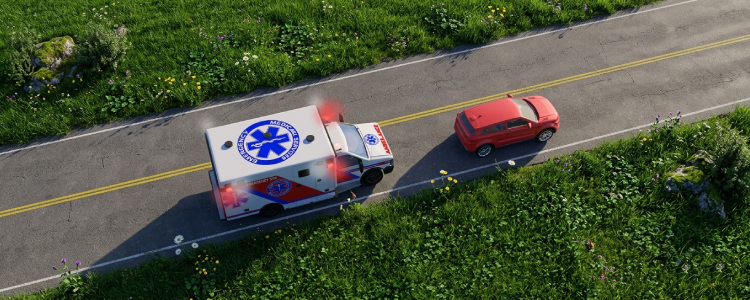
What actions must you take when an emergency vehicle with flashing lights, a siren, or an air horn is coming toward you from either side?

  1. reduce speed and move into the left lane
  2. switch to another lane and continue driving at the same speed.
  3. pull over to the right and stop
  4. boost your speed and continue moving.

Correct answer

pull over to the right and stop

Explanation

💡Emergency Vehicles

You must yield the right-of-way to fire, ambulance, police and other authorized emergency vehicles when they respond to emergencies. They will display lights that are flashing red, red and blue or red and white and sound a siren or air-horn. (Vehicles responding to emergencies for a Police Department, Sheriff Department or the New York State Troopers are not always required to use an audible siren or horn.) When you hear or see an emergency vehicle heading toward your vehicle from any direction, safely pull over immediately to the right edge of the road and stop. Wait until the emergency vehicle passes before you drive on. If you are in an intersection, drive out of it before you pull over.

You must pull over and stop for an emergency vehicle even if it is headed toward you in the opposite lane of a two-way roadway.

If you hear a siren or air-horn close by but do not know exactly where the emergency vehicle is, you must safely pull over to the right-side edge of the road and stop until you are sure it is not headed toward you.

An emergency vehicle that uses lights and a siren or air-horn can be unpredictable. The driver can legally exceed the speed limit, pass red lights and STOP or YIELD signs, go the wrong way on one-way streets and turn in directions not normally allowed. Although emergency vehicle drivers are required to be careful, be very cautious when an emergency vehicle heads toward you.

Question 3 of 15

Visual for New York practice question 3

How many feet does New York State law require you to signal at least before you turn?

  1. 50 feet ahead
  2. 15 feet ahead
  3. 80 feet ahead
  4. 100 feet ahead

Correct answer

100 feet ahead

Explanation

💡 Always signal before you turn or change lanes. It is important that other highway users know your intentions. The law requires you to signal a turn or lane change with your turn lights or hand signals at least 100 feet (30 m) ahead. A good safety tip is, when possible, to signal your intention to turn before you begin to brake or make the turn.

Question 4 of 15

Visual for New York practice question 4

At least how many feet from a stopped school bus with its red lights flashing must vehicles approaching from either direction stop in New York State?

  1. 20 feet
  2. 15 feet
  3. 10 feet
  4. 30 feet

Correct answer

20 feet

Explanation

💡 School Buses When a stopped school bus flashes its red light(s), traffic that approaches from either direction, even in front of the school and in school parking lots, must stop before it reaches the bus. You should stop at least 20 feet (6 m) away from the bus. You can identify this bus by a "SCHOOL BUS" sign, the red lights on the top, and its unique yellow orange color.

Before a school bus stops to load or discharge passengers, the driver will usually flash yellow warning lights which are located on the front and back of the bus near the roof. When you see them, decrease speed and be prepared to stop.

When you stop for a school bus, you cannot drive again until the bus starts moving again or when the bus driver or a traffic officer signals that you can proceed. This law applies on all roadways in New York State. You must stop for a school bus even if it is on the opposite side of a divided highway.

After you stop for a school bus, look for children along the side of the road. Drive slowly until you have passed them.

Safety Tip: Most school bus-related deaths and injuries occur while children cross the street after being discharged from the bus, not in collisions that involve school buses.

💡 Remember that vehicles that transport people with disabilities can be equipped as school buses and you must stop for them as you would for other school buses.

Question 5 of 15

Visual for New York practice question 5

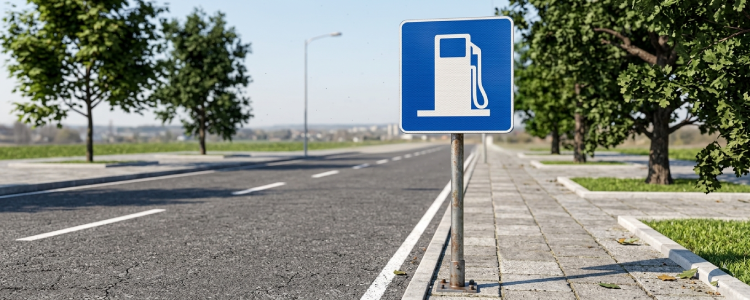
The service sign indicates

  1. a gas station.
  2. a campsite.
  3. a drink area.
  4. a telephone service.

Correct answer

a gas station.

Explanation

The image depicts a blue service sign featuring a gas pump symbol. Such signs are used to indicate the presence of a gas station, providing a facility for refueling vehicles.

💡 To remember: The image of the gas pump on the sign resembles the equipment used to fill your vehicle, pointing to a gas station nearby.

Question 6 of 15

Visual for New York practice question 6

To maintain enough distance between your car and the car in front of you, it is recommended to use the

  1. one-second rule.
  2. two-second rule.
  3. five-second rule.
  4. zero-second rule.

Correct answer

two-second rule.

Explanation

💡 For a good "space cushion," use the 2-second rule: Select an object near or above the road ahead like a sign, tree or overpass. As the vehicle ahead passes it, count slowly, "one thousand one, one thousand two." If you reach the same object before you finish the count, you are following too closely. In bad weather and when following large trucks, increase the count to at 3 three or 4 seconds for additional space.

Question 7 of 15

Visual for New York practice question 7

If you find yourself being tailgated by another driver, the recommended action is to

  1. boost your speed.
  2. if necessary, reduce your speed and pull off the road.
  3. engage the brakes and dissuade the driver.
  4. change lanes to the left.

Correct answer

if necessary, reduce your speed and pull off the road.

Explanation

If you find yourself being tailgated, it is safest to reduce your speed gradually and, if necessary, pull off the road to allow the tailgating driver to pass. This action reduces the risk of a collision by increasing the distance between your vehicle and the tailgater, thereby enhancing safety for both drivers.

💡 Remember: Prioritize safety by creating space and allowing aggressive drivers to pass.

Question 8 of 15

Visual for New York practice question 8

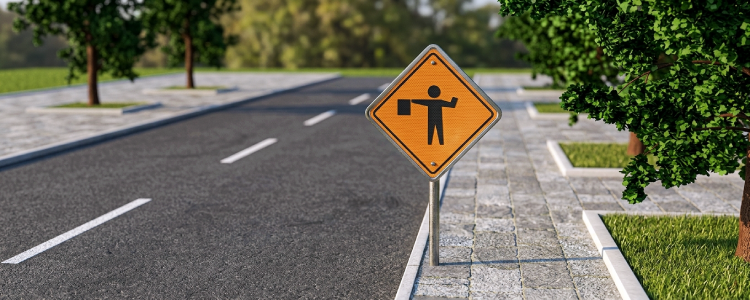
What does this sign mean?

  1. There is a crew working up ahead.
  2. There is a flagger up ahead.
  3. There is a circular intersection coming up.
  4. There is a traffic officer up ahead.

Correct answer

There is a flagger up ahead.

Explanation

💡 This sign warns of a flagger ahead. The figure holding a flag indicates that a person may be directing vehicles due to construction, road work, or other temporary road conditions.

Flaggers are workers in construction or maintenance zones who help stop, slow, or guide vehicles safely through the area. They wear bright-colored or fluorescent safety vests and use flags or signs to direct drivers.

Question 9 of 15

Visual for New York practice question 9

At what distance should you reduce your headlights to low beam when approaching an incoming vehicle, according to guidelines?

  1. 200 feet
  2. 300 feet
  3. 400 feet
  4. 500 feet

Correct answer

500 feet

Explanation

💡 Be considerate when you use your high beams. Your headlights must be on low beam when you are within 500 feet (150 m) of an oncoming vehicle or within 200 feet (60 m) of a vehicle ahead of you, even if the vehicle ahead is in a different lane. You should also dim your lights for pedestrians who approach you. Any fog or driving lights your vehicle has must be arranged, adjusted or operated to avoid dangerous glare to other drivers. 🚘 Oncoming vehicle → 500 feet = dim lights 🚗 Vehicle ahead → 200 feet = dim lights

Question 10 of 15

Visual for New York practice question 10

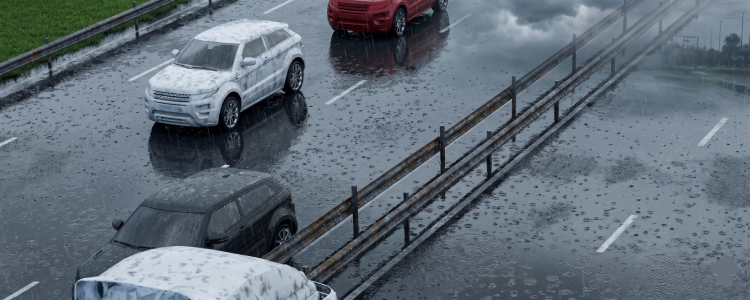
When it's raining, your car's tires may glide on water, causing them to lose contact with the surface. This situation is called

  1. blind spot.
  2. tailgating.
  3. hydroplaning.
  4. tire pressure.

Correct answer

hydroplaning.

Explanation

In heavy rain, your tires can begin to ride on the water that is on top of the road pavement. This is called "hydroplaning" and can cause complete loss of traction and control of steering. Hydroplaning normally occurs at higher speeds, but it also can occur if your tires are tread worn or not inflated properly. When there is heavy rain, it always makes sense to drive more slowly. If your vehicle begins to lose traction, decrease your speed even more. Good tires with deep tread help to prevent hydroplaning.

Question 11 of 15

Visual for New York practice question 11

What should you use to enhance visibility in fog, rain, or snow?

  1. high-beam headlights.
  2. low-beam headlights.
  3. emergency lights.
  4. lights inside a vehicle.

Correct answer

low-beam headlights.

Explanation

Headlights on high beams reflect rain, fog and snow as it falls. This makes it even harder for you to see. For better visibility during these weather conditions, keep your headlights on low beam. Reduce your speed. Signal your turns further ahead of time to give other drivers and roadway users more warning. Brake early when you decrease speed behind another vehicle or come to an intersection stop.

Some vehicles have front fog lights or front and back fog lights, for use when heavy fog or similar hazardous weather conditions restrict visibility. In New York State, all fog lights must be correctly installed and of a type approved by the Commissioner of DMV. Front fog lights can be amber or white in color. Back fog lights must be red and can be larger than the normal back lights - they will give advance warning of the presence of your vehicle to the drivers behind you. When visibility improves, you can switch off your fog lights to reduce the glare that can bother other drivers.

Question 12 of 15

Visual for New York practice question 12

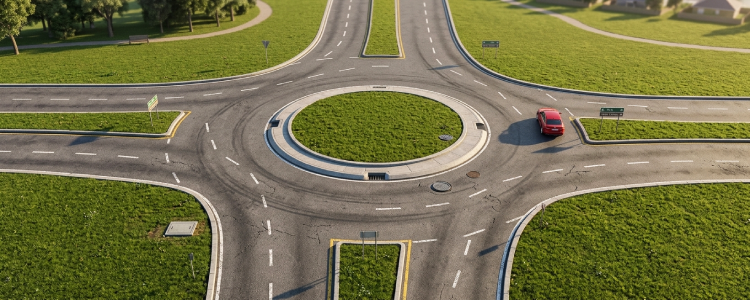
Traffic circulates in a roundabout

  1. a counter-clockwise direction.
  2. a clockwise direction.
  3. in both ways.
  4. the direction shown by traffic lights.

Correct answer

a counter-clockwise direction.

Explanation

💡 Roundabouts (Intersections) A roundabout is a circular intersection with no traffic signal. • Direction: Traffic travels in a one-way, counter-clockwise direction. • Yielding: Drivers entering the roundabout must yield to traffic already inside the circle. If there is no traffic, you may enter without yielding. • No Stopping: Do not stop inside the roundabout. If an emergency vehicle (ambulance/police) approaches with sirens, exit the roundabout first, then pull over. • No Lane Changes: Do not change lanes inside the roundabout. Choose your lane before entering. • Exit Signaling: Always use your right turn signal before exiting to let others know your intentions.

💡 Multi-Lane Roundabouts In a multi-lane roundabout, you must choose the correct lane based on where you want to go: • Right Lane: Use to go Right or Straight. • Left Lane: Use to go Straight, Left, or make a U-turn. • Yield to Pedestrians: Always yield to pedestrians in crosswalks before entering or exiting. • Large Vehicles: Be careful around trucks and buses; they may need to occupy both lanes to turn. Never try to pass a large vehicle inside the roundabout. • Bicyclists: May "take the lane" (ride in the center) or use the sidewalk/shared path.

Question 13 of 15

Visual for New York practice question 13

When you're in a roundabout, you should NOT

  1. signal before exiting.
  2. yield the right-of-way to pedestrians.
  3. stop before you're ready to exit.
  4. stay in your lane until you're ready to exit.

Correct answer

stop before you're ready to exit.

Explanation

💡 Roundabouts (Intersections) A roundabout is a circular intersection with no traffic signal. • Direction: Traffic travels in a one-way, counter-clockwise direction. • Yielding: Drivers entering the roundabout must yield to traffic already inside the circle. If there is no traffic, you may enter without yielding. • No Stopping: Do not stop inside the roundabout. If an emergency vehicle (ambulance/police) approaches with sirens, exit the roundabout first, then pull over. • No Lane Changes: Do not change lanes inside the roundabout. Choose your lane before entering. • Exit Signaling: Always use your right turn signal before exiting to let others know your intentions.

💡 Multi-Lane Roundabouts In a multi-lane roundabout, you must choose the correct lane based on where you want to go: • Right Lane: Use to go Right or Straight. • Left Lane: Use to go Straight, Left, or make a U-turn. • Yield to Pedestrians: Always yield to pedestrians in crosswalks before entering or exiting. • Large Vehicles: Be careful around trucks and buses; they may need to occupy both lanes to turn. Never try to pass a large vehicle inside the roundabout. • Bicyclists: May "take the lane" (ride in the center) or use the sidewalk/shared path.

Question 14 of 15

Visual for New York practice question 14

To turn left from a one-way street onto a two-way street, you should be in

  1. the right lane
  2. the left lane
  3. the middle lane
  4. any lane

Correct answer

the left lane

Explanation

To turn left from a one-way street onto a two-way street, you should use the left lane. This ensures that the turn is made safely into the correct lane of the two-way traffic, minimizing the risk of crossing into oncoming traffic.

Question 15 of 15

Visual for New York practice question 15

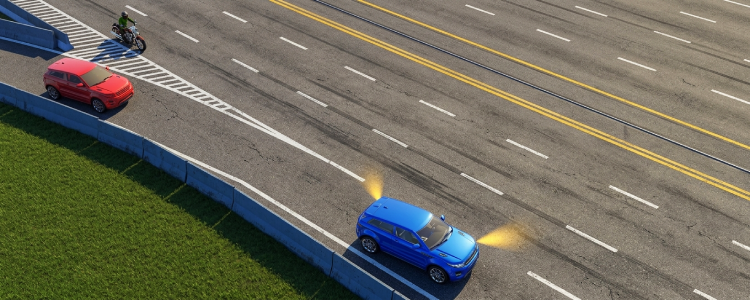
To enter an expressway, it is necessary to

  1. stop before entering the expressway
  2. enter the expressway at 50 miles per hour.
  3. begin driving on the expressway at a maximum speed.
  4. enter the expressway at or near the speed of expressway traffic.

Correct answer

enter the expressway at or near the speed of expressway traffic.

Explanation

To enter an expressway safely and effectively, a driver must adjust to the speed of the traffic already on the expressway. This approach ensures a smooth merge and minimizes disruptions to the traffic flow. Entering too slowly or too quickly can create dangerous situations and hinder other drivers.