Skip to content
USA

California visual practice

California practice test 1: Questions and answers

Review all 15 selected questions before you try the interactive test again.

Question 1 of 15

Visual for California practice question 1

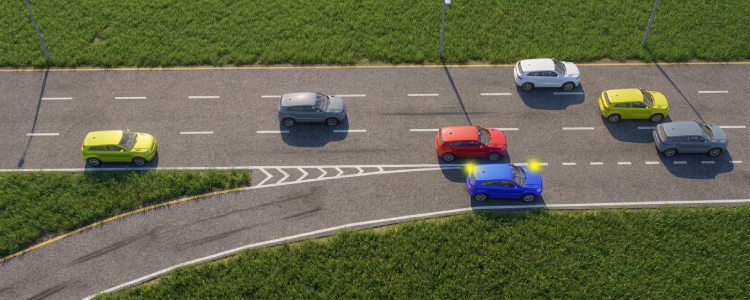
The broken white lines on the road indicate that

  1. passing is prohibited
  2. the traffic travels in opposite directions.
  3. passing is permitted if done safely.
  4. passing is only permitted on the right side

Correct answer

passing is permitted if done safely.

Explanation

💡 Lane Markings Lane markings on road surfaces help drivers know which part of the road to use and understand traffic rules. ◆ Single Solid Yellow Line A single solid yellow line marks the center of a road with two-way traffic. Do not pass a vehicle in front of you if there is only one lane of traffic going your direction and a solid yellow line on your side of the road. ◆ Double Solid Yellow Lines Do not pass over double solid yellow lines. Stay to the right of these lines unless you are: • In a high-occupancy vehicle (HOV) carpool lane that has a designated entrance on the left. • Instructed by construction or other signs to drive on the other side of the road because your side is closed or blocked. • Turning left across a single set of double yellow lines to enter or exit a driveway or private road or make a U-turn. Two sets of solid double yellow lines spaced two or more feet apart are considered a barrier. Do not drive on or over this barrier, make a left turn, or make a U-turn across it, except at designated openings. ◆ Broken Yellow Line A broken yellow line indicates you may pass if the broken line is next to your driving lane. Only pass when it is safe. ◆ Single Solid White Line A single solid white line marks traffic lanes going in the same direction. This includes one-way streets. ◆ Double Solid White Lines Double solid white lines indicate a lane barrier between a regular use and a preferential use lane, such as a carpool (HOV) lane. You may also see double solid white lines in or near freeway on and off ramps. Never change lanes over double solid white lines. Wait until you see a single broken white line. ◆ Broken White Lines Broken white lines separate traffic lanes on roads with two or more lanes in the same direction. ◆ End of Lane Markings Ending freeway and street lanes are usually marked with large broken lines. If you are driving in a lane marked with broken lines, be prepared to exit the freeway or for the lane to end. Look for a sign that tells you to exit or merge. ◆ Yield Line A yield line is a line of solid white triangles that shows approaching vehicles where to yield or stop. The triangles point towards approaching vehicles.

Question 2 of 15

Visual for California practice question 2

A solid red arrow signal indicates

  1. you must stop and then continue when it's safe.
  2. you must stop and you cannot turn in the direction of the arrow.
  3. you should prepare to stop and yield to oncoming traffic before turning.
  4. you may make a quick turn in the direction of the arrow.

Correct answer

you must stop and you cannot turn in the direction of the arrow.

Explanation

—🚦 Solid Signal Lights— 🔴 SOLID RED LIGHT A red traffic signal light means STOP. You can turn right at a red light, if: • There is not a NO TURN ON RED sign posted. • You stop at the stop or limit line, yield for pedestrians, and turn when it is safe.

🟡 SOLID YELLOW LIGHT A yellow traffic signal light means CAUTION. The light is about to turn red. When you see a yellow traffic signal light, stop, if you can do so safely. If you cannot stop safely, cautiously cross the intersection.

🟢SOLID GREEN LIGHT A green traffic signal light means GO. You should still stop for any vehicle, bicyclist, or pedestrian in the intersection. Only proceed if you have enough space without creating a danger to any oncoming vehicle, bicyclist, or pedestrian. Do not enter the intersection if you cannot get completely across before the traffic signal light turns red.

⬅ 🔴 Red Arrow A red arrow means STOP. Do not turn at a red arrow. Remain stopped until a green traffic signal light or green arrow appears.

⬅ 🟢Green Arrow A green arrow means GO in the direction the arrow is pointing. The green arrow allows you to make a protected turn. Oncoming vehicles are stopped by a red traffic signal light.

⬅ 🟡 Yellow Arrow A yellow arrow means the protected turning time is ending. The signal will change soon. If you cannot stop safely or you are already in the intersection, cautiously complete your turn. Pay attention to the next signal. It could be a: — Green or red traffic signal light. — Red arrow.

◆ Traffic Light Not Working When a traffic light is not working, stop as if the intersection is controlled by STOP signs in all directions. Then proceed cautiously when it is safe to do so.

Question 3 of 15

Visual for California practice question 3

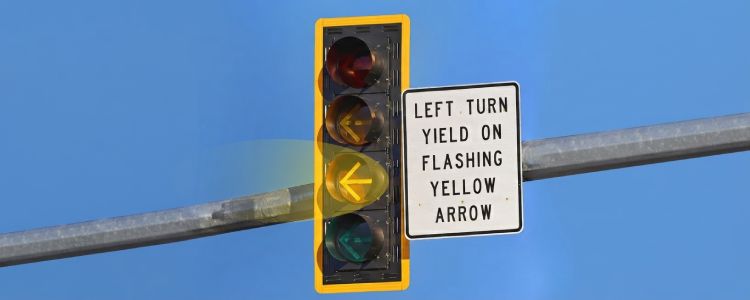
You see a traffic signal displaying a flashing yellow arrow. What should you do?

  1. You can turn left freely here.
  2. You can turn left after you yield to oncoming vehicles.
  3. You can drive in any direction without yielding to oncoming vehicles.
  4. You can turn left without yielding to oncoming vehicles.

Correct answer

You can turn left after you yield to oncoming vehicles.

Explanation

🚦Protected-Permissive Left-Turn Signal - (FYA) signals

🔴 Red Light: Prohibits movement and left turns (same as a standard traffic light). Similarly, a solid green light allows normal movement. Similarly, solid yellow light warns that the signal is changing from green to red, and you should stop if it is safe to do so.

⬅ 🟢 Steady Green Arrow: Means a protected turn—oncoming traffic has a red light, so you can turn left with the right-of-way.

⬅ 🟡 Steady Yellow Arrow: Warns that the protected phase is ending and a red signal is about to appear (prepare to stop or clear the intersection if you are already turning).

⬅ ⚡ Flashing Yellow Arrow: Allows you to turn left, but you must yield to oncoming traffic and pedestrians.

Before the introduction of flashing yellow arrow (FYA) signals, a standard circular green signal was often used for permitted left turns. Many drivers, out of habit, perceived the green color as an absolute signal to move ("green means go") and turned left while forgetting the need to yield to oncoming traffic, which often led to accidents. This is exactly why the Federal Highway Administration (FHWA) introduced the flashing yellow arrow as a national standard: a flashing yellow light is intuitively associated with caution and the need to be careful (unlike green), making it clear to drivers that they must yield to oncoming vehicles and pedestrians.

Question 4 of 15

Visual for California practice question 4

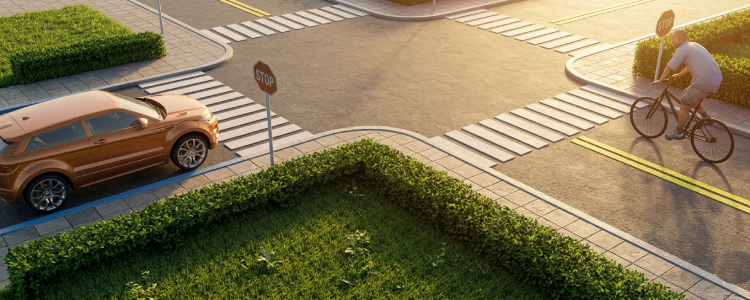
What should you do if a bicycle on your right reaches an intersection at the same time as you do?

  1. yield to the bicycle.
  2. proceed because you have the right-of-way.
  3. proceed slowly along with the bicycle.
  4. speed up and go quickly.

Correct answer

yield to the bicycle.

Explanation

💡 Intersections An intersection is any place where one road meets another road. Controlled intersections have signs or traffic signal lights. Uncontrolled and blind intersections do not. Before entering an intersection, look left, right, and ahead to check for vehicles, bicyclists, and pedestrians. Be prepared to slow down and stop if necessary. Pedestrians always have the right-of-way. Here are some right-of-way rules at intersections: ◆ Without STOP or YIELD signs: The vehicle that arrives to the intersection first has the right-of-way. However, if a vehicle, pedestrian, or bicyclist gets to the intersection at the same time as you, give the right-of-way to the vehicle, pedestrian, or bicyclist on your right. If you approach a stop sign and there is a stop sign on all four corners, stop first and proceed as above. ◆ T intersections without STOP or YIELD signs: Vehicles, bicyclists, and pedestrians on the through road (continuing to go straight) have the right-of-way. ◆ Turning left: Check for pedestrians. Give the right-of-way to any pedestrian or approaching vehicle that is close enough to be dangerous. ◆ Turning right: Always check for pedestrians crossing the street, and motorcycles and bicycles riding next to you. ◆ Green traffic signal light: Proceed with caution. Pedestrians have the right-of-way.

💡 At a four-way STOP: 🕰️ Vehicles move through the intersection in the order they arrived (first to arrive is first to move forward). 🕰️ If multiple vehicles arrive at the same time, the driver on the left yields to the driver on the right. ⚠️ Many people make a mistake on this question because traffic rules are different in other countries. Read it carefully several times!

Question 5 of 15

Visual for California practice question 5

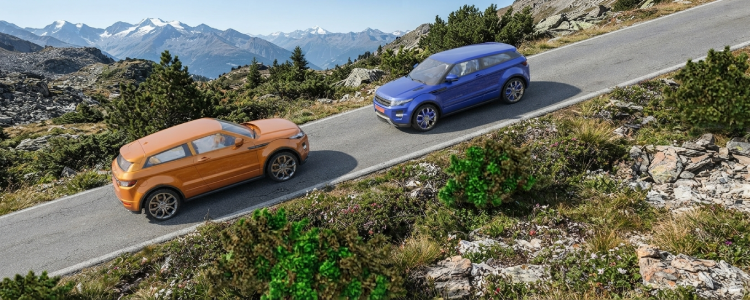
When two cars meet on a steep mountain road where passing is impossible, which vehicle has the right-of-way?

  1. Both cars
  2. The car is driving uphill
  3. The car is driving downhill
  4. None of the cars

Correct answer

The car is driving uphill

Explanation

💡Mountain Roads If two vehicles meet on a steep narrow road and neither vehicle can pass, the vehicle facing uphill has the right-of-way. The vehicle facing downhill has more control when backing up the hill. The vehicle facing downhill should back up until the vehicle going uphill can pass.

Question 6 of 15

Visual for California practice question 6

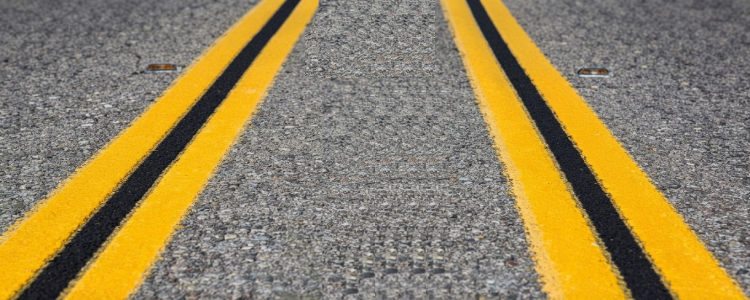
Two sets of solid double yellow lines on the road spaced two or more feet apart mean

  1. two-way traffic.
  2. a parking area.
  3. a barrier.
  4. a detour.

Correct answer

a barrier.

Explanation

💡 Two sets of solid double yellow lines spaced two or more feet apart are considered a barrier. Do not drive on or over this barrier, make a left turn, or make a U-turn across it, except at designated openings.

Question 7 of 15

Visual for California practice question 7

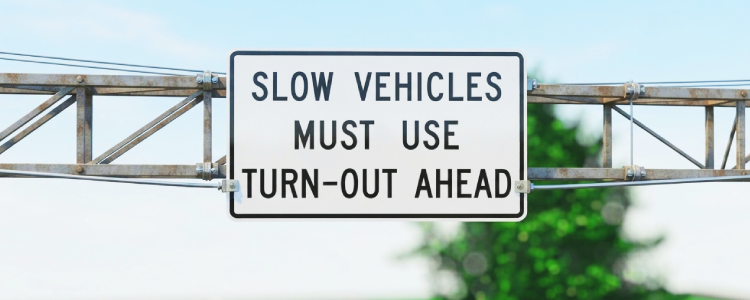
Marked 'turnout' zones on a two-lane road

  1. allow vehicles to perform U-turns.
  2. allow vehicles to make right turns.
  3. allow vehicles to pass.
  4. do not allow vehicles to pass.

Correct answer

allow vehicles to pass.

Explanation

💡 Turnout Areas or Lanes Some two-lane roads have special turnout areas or lanes. Merge into these areas or lanes to allow cars behind you to pass.

You must use a turnout area or lane to let other vehicles pass when you are driving slowly on a two-lane road, where passing is unsafe, and there are ⚠️ 5 or more vehicles following you.

Question 8 of 15

Visual for California practice question 8

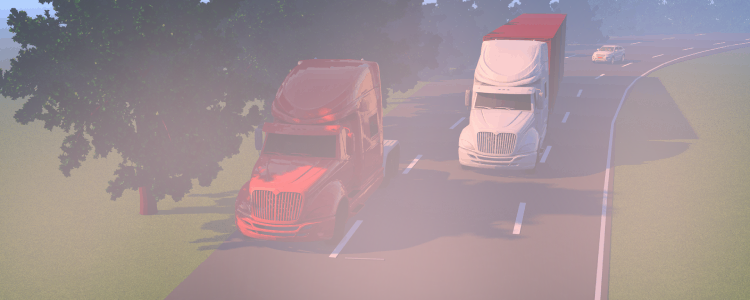
What should you use while driving in fog?

  1. low-beam headlights.
  2. high-beam headlights.
  3. emergency flashers.
  4. horn.

Correct answer

low-beam headlights.

Explanation

Fog reflects and scatters light back toward the driver. Low-beam headlights aim light downward, reducing glare and making the roadway easier to see.

Question 9 of 15

Visual for California practice question 9

What is the first step you should take if you have vehicle trouble and need to stop?

  1. Stop your vehicle over a hill or just around a curve for visibility.
  2. Pull off the road and away from traffic.
  3. Lift the hood to signal an emergency.
  4. Call 911

Correct answer

Pull off the road and away from traffic.

Explanation

The immediate priority is to separate the disabled vehicle from moving traffic, reducing the chance that it will obstruct or be struck by other vehicles.

Question 10 of 15

Visual for California practice question 10

What should you do if your car begins to hydroplane?

  1. apply the brakes.
  2. reduce your speed gradually.
  3. press your gas pedal slowly.
  4. speed up immediately.

Correct answer

reduce your speed gradually.

Explanation

Hydroplaning occurs on a wet roadway, so easing your speed down gradually avoids an abrupt change while the tires have reduced contact with the pavement.

Question 11 of 15

Visual for California practice question 11

A double solid white line

  1. divides two lanes traveling in the same direction, but crossing the line is not allowed.
  2. divides two lanes traveling in the same direction, and crossing the line is allowed.
  3. divides opposing lanes, and crossing the line is not allowed.
  4. means nothing.

Correct answer

divides two lanes traveling in the same direction, but crossing the line is not allowed.

Explanation

💡 Lane Markings Lane markings on road surfaces help drivers know which part of the road to use and understand traffic rules. ◆ Single Solid Yellow Line A single solid yellow line marks the center of a road with two-way traffic. Do not pass a vehicle in front of you if there is only one lane of traffic going your direction and a solid yellow line on your side of the road. ◆ Double Solid Yellow Lines Do not pass over double solid yellow lines. Stay to the right of these lines unless you are: • In a high-occupancy vehicle (HOV) carpool lane that has a designated entrance on the left. • Instructed by construction or other signs to drive on the other side of the road because your side is closed or blocked. • Turning left across a single set of double yellow lines to enter or exit a driveway or private road or make a U-turn. Two sets of solid double yellow lines spaced two or more feet apart are considered a barrier. Do not drive on or over this barrier, make a left turn, or make a U-turn across it, except at designated openings. ◆ Broken Yellow Line A broken yellow line indicates you may pass if the broken line is next to your driving lane. Only pass when it is safe. ◆ Single Solid White Line A single solid white line marks traffic lanes going in the same direction. This includes one-way streets. ◆ Double Solid White Lines Double solid white lines indicate a lane barrier between a regular use and a preferential use lane, such as a carpool (HOV) lane. You may also see double solid white lines in or near freeway on and off ramps. Never change lanes over double solid white lines. Wait until you see a single broken white line. ◆ Broken White Lines Broken white lines separate traffic lanes on roads with two or more lanes in the same direction. ◆ End of Lane Markings Ending freeway and street lanes are usually marked with large broken lines. If you are driving in a lane marked with broken lines, be prepared to exit the freeway or for the lane to end. Look for a sign that tells you to exit or merge. ◆ Yield Line A yield line is a line of solid white triangles that shows approaching vehicles where to yield or stop. The triangles point towards approaching vehicles.
Question 12 of 15

Visual for California practice question 12

What should you do when you want to enter a freeway?

  1. stop before merging into freeway traffic.
  2. stop and yield to the traffic on the freeway.
  3. enter the freeway at or near the speed of freeway traffic.
  4. enter the freeway at a speed more than the speed of freeway traffic.

Correct answer

enter the freeway at or near the speed of freeway traffic.

Explanation

Matching the speed of freeway traffic reduces the speed difference between your vehicle and the vehicles already on the freeway, allowing a smoother merge.

Question 13 of 15

Visual for California practice question 13

In California, the speed limit for a blind intersection is

  1. 10 mph.
  2. 100 mph.
  3. 15 mph.
  4. 40 mph.

Correct answer

15 mph.

Explanation

💡 Blind Intersections An intersection is considered blind if it has no stop signs at any corner. If your view is blocked, move slowly forward until you can see. The speed limit for a blind intersection is 15 mph.

Question 14 of 15

Visual for California practice question 14

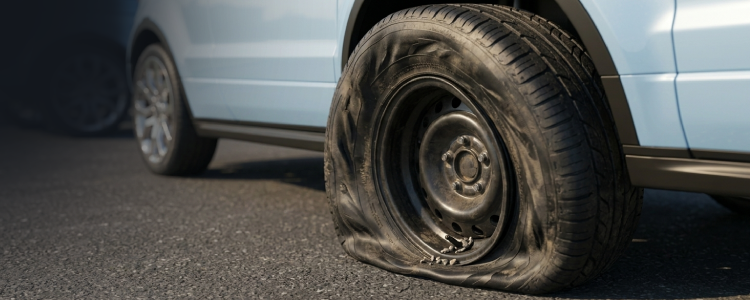
What should you do if a tire suddenly goes flat while driving?

  1. speed up.
  2. hold the steering wheel tightly and keep the car straight.
  3. drive to the left side of the road.
  4. drive to the right side of the road.

Correct answer

hold the steering wheel tightly and keep the car straight.

Explanation

💡Tire Blowouts If you have a tire blowout, do not panic or overreact. Suddenly braking or abruptly removing your foot from the accelerator can result in a loss of control over the vehicle. Instead, you should take the following steps recommended by the National Highway Traffic Safety Administration: • Hold the steering wheel with both hands. • Maintain your vehicle speed if possible and safe. • Gradually release the accelerator. • Correct the steering as necessary to stabilize your vehicle and regain control. • Look and steer in the direction you want your vehicle to go. • Once your vehicle has stabilized, continue to slow down and pull off the road where and when it's safe.

Question 15 of 15

Visual for California practice question 15

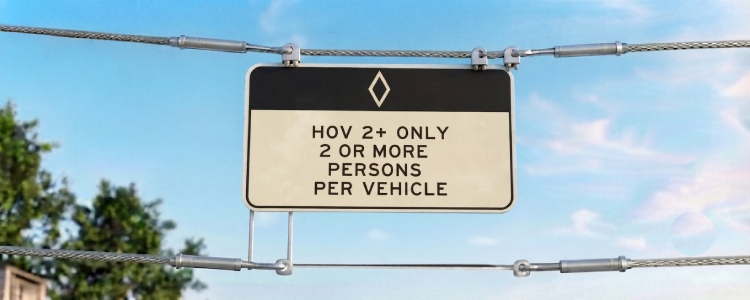
High-Occupancy Vehicle (HOV) lanes are reserved for

  1. heavy trucks.
  2. bicycles.
  3. car pools and vehicles with more than one person.
  4. ambulance vehicles.

Correct answer

car pools and vehicles with more than one person.

Explanation

The diamond symbol and “HOV 2+” are the visible cues: the lane is for vehicles carrying two or more persons, meaning more than one person per vehicle.

💡 Carpool/High-Occupancy Vehicle (HOV) Lanes An HOV lane is a special lane reserved for carpools, buses, motorcycles, or low-emission vehicles with decals. To use an HOV lane, one of these must apply: • You have a certain number of people in your vehicle. There will be signs at the on-ramp or along the road to tell you the minimum number of people. Road signs also list the hours when the HOV rules apply. • You are driving a low emission or zero emission vehicle. You must display a special DMV-issued decal. • You are riding a motorcycle (unless otherwise posted). The road surface in an HOV lane is marked with a diamond symbol and the words Carpool Lane. Do not cross over double solid lines to enter or exit an HOV lane. Use designated entrances and exits.