Skip to content
USA

California visual practice

California practice test 2: Questions and answers

Review all 15 selected questions before you try the interactive test again.

Question 1 of 15

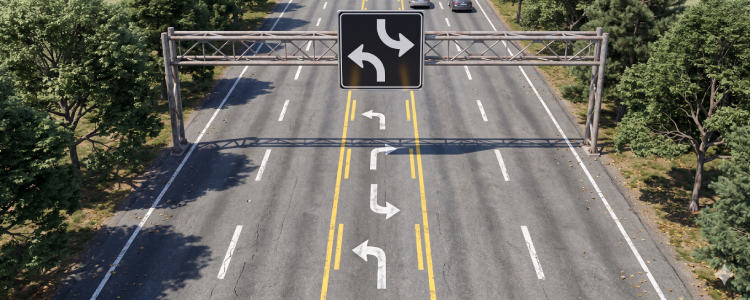
Visual for California practice question 1

A center lane between lanes of traffic moving in opposite directions can be used for

  1. right turns only
  2. passing
  3. left turns or U-turns
  4. parking only

Correct answer

left turns or U-turns

Explanation

💡 Center Left Turn Lanes A center left turn lane is located in the middle of a two-way street. It is marked on both sides by two painted lines. The inner line is broken and the outer line is solid. Use the center left turn lane to prepare for and make a left turn or U-turn. It is not a regular traffic lane or passing lane. You may only drive for 200 feet in the center left turn lane. To turn left from this lane: • Look for other vehicles coming toward you in the center left turn lane. • Signal. • Look over your shoulder to check your blind spots. • Merge completely into the center left turn lane so you do not block traffic. • Turn when it is safe.
Question 2 of 15

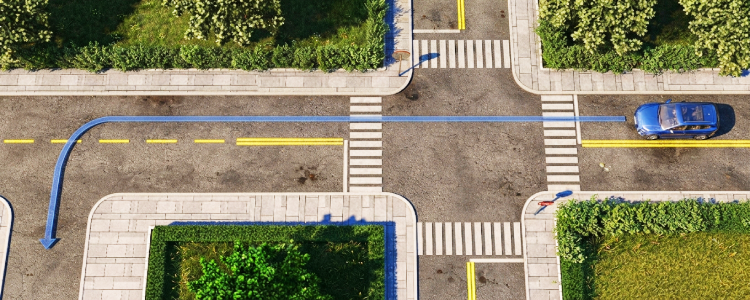
Visual for California practice question 2

When should you start signaling if you intend to turn shortly beyond an intersection?

  1. Signal well before entering the intersection to warn oncoming traffic.
  2. Start signaling when you are almost through the intersection so you do not mislead other drivers.
  3. Signal right as you begin making your turn into the driveway or side street.
  4. It is not necessary to use a turn signal if the turning point is close to the intersection.

Correct answer

Start signaling when you are almost through the intersection so you do not mislead other drivers.

Explanation

Wait until you are almost through the intersection before signaling so other drivers do not mistake your signal for a turn at the intersection. 💡 If you want to turn, start signaling about 100 feet before the turn. If you plan to turn beyond an intersection, do not start signaling until you are in the intersection. If you signal too early, other drivers might think you plan to turn at the intersection and could pull out in front of you.

Question 3 of 15

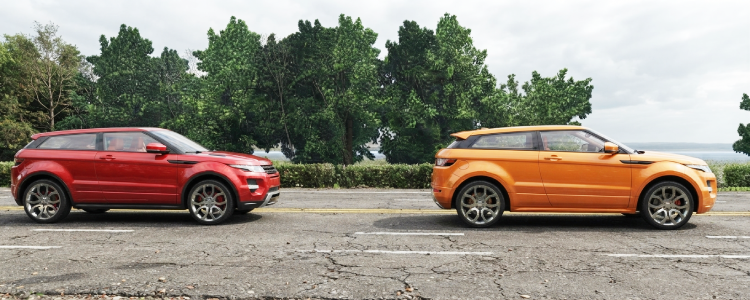
Visual for California practice question 3

A driver is tailgating your vehicle. What should you do?

  1. Speed up to get away from the tailgater.
  2. Do not allow the tailgater to overtake you.
  3. Switch lanes to allow the tailgater to pass.
  4. Brake suddenly to get the attention of the tailgater.

Correct answer

Switch lanes to allow the tailgater to pass.

Explanation

💡 Tailgating makes it harder for you to see the road ahead because the vehicle in front of you blocks your view. You will not have enough time to react if the driver in front of you brakes suddenly. Use the three-second rule to ensure a safe following distance and avoid a collision. Following other vehicles at a safe distance gives you enough time to react if another driver makes a mistake. If a vehicle merges in front of you too closely, take your foot off the accelerator. This creates space between you and the vehicle ahead.

Create more space in front of your vehicle when: • A tailgater is behind you. Maintain your course and speed. Then, when safe to do so, ⚠️ merge right to change into another lane and allow the tailgater to pass. • Following motorcyclists on metal surfaces (bridge gratings, railroad tracks, etc.), and gravel.

Question 4 of 15

Visual for California practice question 4

You should activate your high-beam headlights

  1. All night
  2. At night during rainy weather
  3. When traveling in open country at night or on dark city streets
  4. Anytime you want

Correct answer

When traveling in open country at night or on dark city streets

Explanation

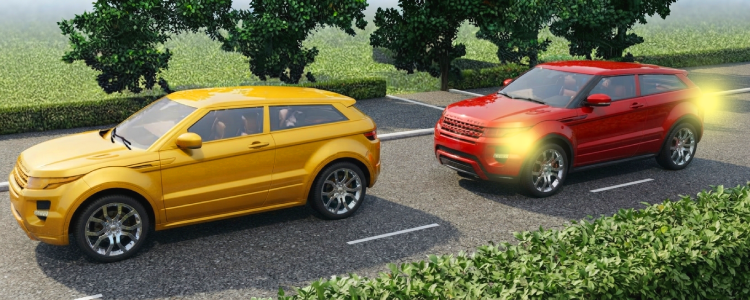
💡 Using Your Headlights Your vehicle's headlights help you see what is in front of you. They also make it easier for other drivers to see your vehicle. Dim your high-beam headlights to low beams within 500 feet of a vehicle coming toward you or within 300 feet of a vehicle you are following. It is illegal to drive using only parking lights. Use your headlights: • When it is too dark to see from 1,000 feet away. • Beginning 30 minutes after sunset. • Until 30 minutes before sunrise. • In adverse weather. If you need to use your windshield wipers due to fog, rain, or snow, you must turn on your low-beam headlights. • When conditions (such as clouds, dust, smoke, or fog) prevent you from seeing other vehicles. • On mountain roads and tunnels (even on sunny days). • When a road sign states that headlights must be on. • To help other drivers see your vehicle, especially when the sun is low on the horizon.

Question 5 of 15

Visual for California practice question 5

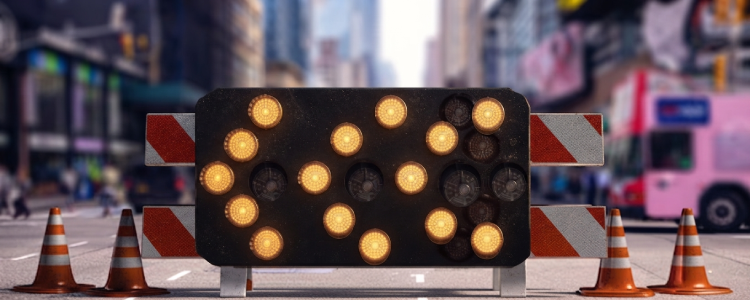
Large electronic flashing arrow panels may be used in work zones day and night to guide drivers

  1. into certain traffic lanes.
  2. into work zones.
  3. into certain parking zones.
  4. into certain U-turn zones.

Correct answer

into certain traffic lanes.

Explanation

The illuminated bulbs form a large directional arrow, making the intended path visible day or night and channeling drivers toward the indicated traffic lane through the work zone.

Question 6 of 15

Visual for California practice question 6

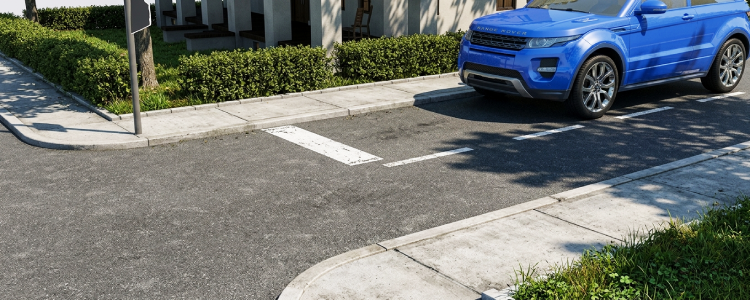
The wide white line marked across a traffic lane before an intersection is called

  1. a limit line
  2. a speed bump
  3. a crosswalk line
  4. a blind line

Correct answer

a limit line

Explanation

💡 Stop behind the limit line. A limit line is a wide white line that shows drivers where to stop before an intersection or crosswalk. If there is no limit line, stop before you enter the crosswalk. If there is no crosswalk, stop before you enter the intersection.

Question 7 of 15

Visual for California practice question 7

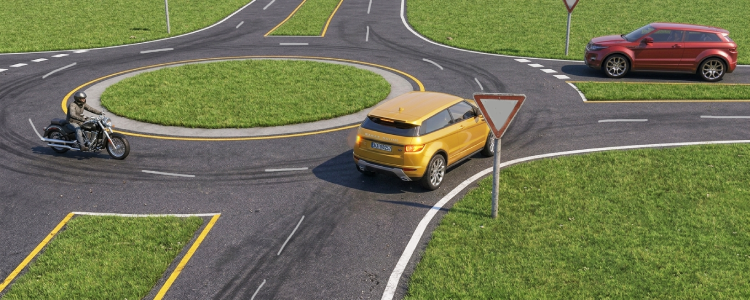
Vehicles entering a roundabout must

  1. come to a full stop and wait for traffic in the roundabout to clear.
  2. yield to the traffic in the roundabout.
  3. enter the roundabout to the left of the central island.
  4. not yield to the traffic in the roundabout.

Correct answer

yield to the traffic in the roundabout.

Explanation

The triangular yield sign at the entrance is the visual cue that traffic already circulating has priority, preventing an entering vehicle from moving into its path. 💡 How to Use a Roundabout: • Slow down as you approach the roundabout. • Yield to all traffic already in the roundabout. • Enter the roundabout when there is a safe gap in traffic, traveling in a counter-clockwise direction. • Keep moving once inside the roundabout; do not stop or pass other vehicles unless directed by emergency personnel.

Question 8 of 15

Visual for California practice question 8

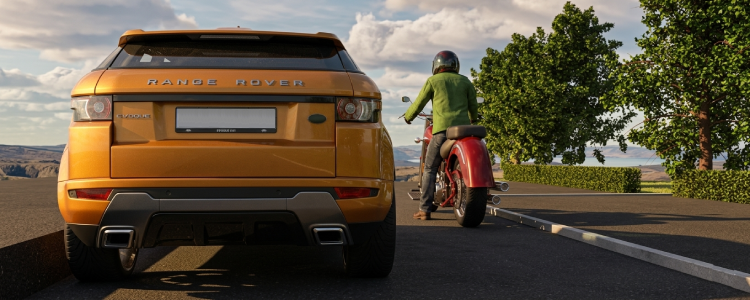
Car drivers should avoid driving next to a motorcycle in the same lane because

  1. motorcyclists might create confusion for the car driver
  2. motorcycles need the full width of the lane.
  3. motorcycles do not have signal lights.
  4. motorcycles can’t go as fast as cars.

Correct answer

motorcycles need the full width of the lane.

Explanation

A motorcycle’s narrow size does not mean the lane can be shared side by side. Treat the entire lane as the motorcycle’s space; driving alongside would crowd the width it needs.

💡Motorcycles Motorcyclists have the same rights and responsibilities as other vehicle drivers. To safely share the road with motorcyclists: • Check for motorcycles and use your mirrors when you change lanes or enter a road. Motorcycles are smaller in size and harder to see so they easily disappear in vehicle blind spots. • Allow a safe three-second following distance. This space will help you avoid hitting a motorcyclist if they brake suddenly or fall. • Whenever possible, give a motorcycle the full lane. It is legal to share lanes with motorcycles, this is known as lane splitting. • Never try to pass a motorcycle in the same lane as you. • Check for motorcyclists before you open your door next to traffic. • When possible, move to one side of your lane to give motorcyclists more room to pass. Road conditions can cause motorcyclists to suddenly change speed or direction.

Question 9 of 15

Visual for California practice question 9

When approaching a pedestrian who is standing at the curb, how can you tell if they are ready to cross the street?

  1. If a pedestrian makes eye contact with you, they are ready to cross the street, and you must yield.
  2. They will wave their hand to signal that you must stop.
  3. Pedestrians are legally required to press a button before they are allowed to look at you.
  4. You do not need to yield unless they are already in the middle of your lane.

Correct answer

If a pedestrian makes eye contact with you, they are ready to cross the street, and you must yield.

Explanation

Watch the pedestrian’s face, not just their feet: eye contact while they are at the curb signals that they are ready to cross, so you must yield. 💡 When there is a pedestrian crossing a roadway with or without a crosswalk, you must use caution, reduce your speed, or stop to allow the pedestrian to safely finish crossing. Other things to keep in mind: • Do not pass a vehicle stopped at a crosswalk. You may not be able to see a pedestrian crossing the street. • ⚠️ If a pedestrian makes eye contact with you, they are ready to cross the street. Yield to the pedestrian. • Always allow pedestrians enough time to safely cross a street as some groups such as seniors, people with small children, and people with disabilities may require extra time.

Question 10 of 15

Visual for California practice question 10

You have just parallel parked on the right side of the street. What should you do before pulling out into traffic?

  1. signal a right turn and check over your right shoulder
  2. signal a left turn and check over your right shoulder
  3. signal a left turn and check over your left shoulder
  4. signal a right turn and check over your left shoulder

Correct answer

signal a left turn and check over your left shoulder

Explanation

Pulling away from the right curb moves your vehicle left into traffic, so signal in that direction and look over your left shoulder to check the area you are entering. 💡 Parallel Parking Steps: When you are ready to leave the space: 1. Check your mirrors 2. Look over your shoulder to check your blind spots 3. Signal your intention to pull out 4. Yield to oncoming traffic before pulling out into the lane

Question 11 of 15

Visual for California practice question 11

At an intersection, a steady yellow arrow signal pointing left means

  1. the signal is about to switch to a green or red light or a red arrow.
  2. you must speed up.
  3. oncoming traffic is stopped and you may make a left turn.
  4. you must turn right.

Correct answer

the signal is about to switch to a green or red light or a red arrow.

Explanation

🚦Protected-Permissive Left-Turn Signal - (FYA) signals

🔴 Red Light: Prohibits movement and left turns (same as a standard traffic light). Similarly, a solid green light allows normal movement. Similarly, solid yellow light warns that the signal is changing from green to red, and you should stop if it is safe to do so.

⬅ 🟢 Steady Green Arrow: Means a protected turn—oncoming traffic has a red light, so you can turn left with the right-of-way.

⬅ 🟡 Steady Yellow Arrow: Warns that the protected phase is ending and a red signal is about to appear (prepare to stop or clear the intersection if you are already turning).

⬅ ⚡ Flashing Yellow Arrow: Allows you to turn left, but you must yield to oncoming traffic and pedestrians.

Before the introduction of flashing yellow arrow (FYA) signals, a standard circular green signal was often used for permitted left turns. Many drivers, out of habit, perceived the green color as an absolute signal to move ("green means go") and turned left while forgetting the need to yield to oncoming traffic, which often led to accidents. This is exactly why the Federal Highway Administration (FHWA) introduced the flashing yellow arrow as a national standard: a flashing yellow light is intuitively associated with caution and the need to be careful (unlike green), making it clear to drivers that they must yield to oncoming vehicles and pedestrians.

Question 12 of 15

Visual for California practice question 12

The school bus you are following has its yellow lights flashing. What does this mean?

  1. The bus is stopping for passengers; you must stop immediately.
  2. The bus is preparing to stop for passengers; you must slow down and prepare to stop.
  3. The bus is signaling you to pass; do so only when it is safe.
  4. The bus is about to pull over and let you overtake; you may proceed at your usual speed.

Correct answer

The bus is preparing to stop for passengers; you must slow down and prepare to stop.

Explanation

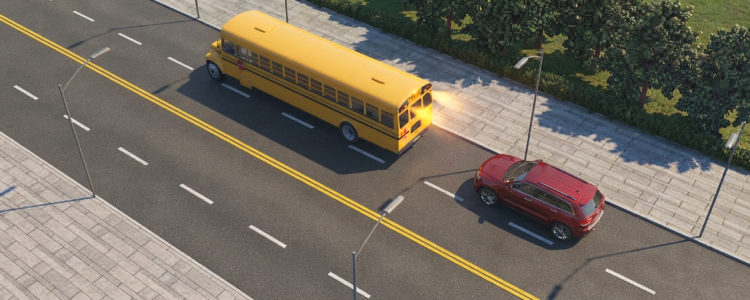
💡 Around Children The speed limit is 25 mph within 500 feet of a school while children are outside or crossing the street. Some school zones may have speed limits as low as 15 mph. When near schools, look for: ◆ Bicyclists and pedestrians. ◆ School safety patrols or crossing guards. Be sure to obey their directions at all times. ◆ Stopped school buses and children crossing the street. - Some school buses flash yellow lights when preparing to stop to let children off the bus. The yellow flashing lights warn you to slow down and prepare to stop. - When the bus flashes red lights (located at the top, front, and back of the bus), you must stop from either direction until the children are safely across the street and the lights stop flashing. Remain stopped while the red lights are flashing. If you fail to stop, you may be fined up to $1,000 and your driving privilege could be suspended for one year. - If the school bus is on the other side of a divided or multilane highway (two or more lanes in each direction), you do not need to stop.

Question 13 of 15

Visual for California practice question 13

A vehicle is stopped at a crosswalk in front of you. What should you do?

  1. Pass slowly if you do not see a pedestrian in front of the vehicle.
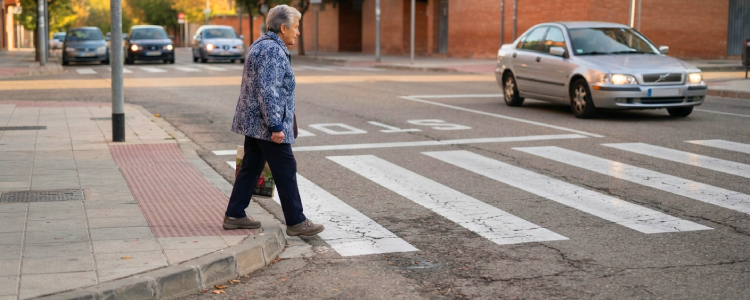
  2. Do not pass the vehicle because a pedestrian may be crossing but hidden from view.
  3. Sound your horn and pass on the left.
  4. Drive around it on the shoulder if the shoulder is clear.

Correct answer

Do not pass the vehicle because a pedestrian may be crossing but hidden from view.

Explanation

💡A stopped vehicle can block your view of a pedestrian in the crosswalk, as shown by the person partly hidden behind the vehicle ahead. Treat the stopped vehicle as a visual cue that someone may be crossing, even if you cannot see them. ⚠️ Many accidents occur this way. Always remember this rule.

Question 14 of 15

Visual for California practice question 14

You are preparing to make a right turn across a marked bus-only lane. What is permitted?

  1. You may drive in the bus lane whenever regular traffic is congested.
  2. You must never cross a bus lane, even to make a right turn.
  3. You may cross the bus lane to make the right turn, but may not otherwise drive, stop, park, or leave a vehicle in it.
  4. You may park in the bus lane while waiting for the turn signal to change.

Correct answer

You may cross the bus lane to make the right turn, but may not otherwise drive, stop, park, or leave a vehicle in it.

Explanation

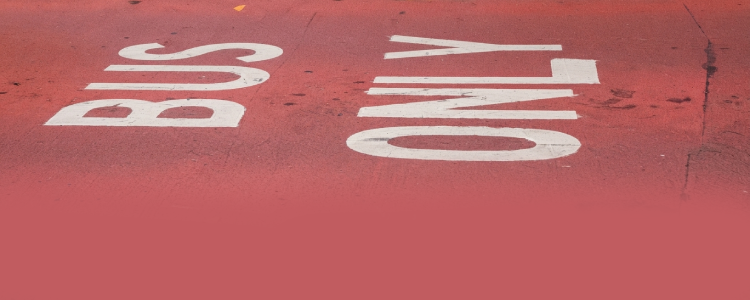
💡Right Turn at a Public Transit Bus Lane It is illegal to drive, stop, park, or leave a vehicle in an area designated for public transit buses. Signs will be posted to indicate the lanes are for bus only. However, you may cross a bus lane to make a right turn.

Question 15 of 15

Visual for California practice question 15

Which statement about passing a vehicle is FALSE?

  1. Do not overtake more than one vehicle at a time.
  2. Do not follow another vehicle that is passing a car in front of you.
  3. You can exceed the speed limit to pass quickly.
  4. Do not pass a vehicle when it is unsafe.

Correct answer

You can exceed the speed limit to pass quickly.

Explanation

💡 Passing quickly does not make exceeding the speed limit permissible; the speed limit still applies while overtaking.